What is Wind-Loading & How to Specify

.jpg)
What Are the Wind Ratings & Design Pressures for Industrial High-Speed Doors?
Protecting your facility against extreme weather and structural failure is vital to maintaining operational uptime. When specifying high-speed roll-up doors or industrial door systems, evaluating their wind load resistance guarantees long-term durability and safety - especially during severe coastal weather, high-wind events, or hurricane conditions.
While wind loading is a critical technical specification for exterior industrial doors, it can sometimes be misunderstood. Unlike standard static doors, high-speed flexible fabric doors and rigid fast-acting doors are rated by Design Pressure (DP) expressed in Pounds per Square Foot (PSF), as well as equivalent wind speed capability (mph).
Key Difference: Test standards evaluate the structural resistance (differential pressure) across a fully closed door. Positive pressure measures the wind pushing against the outside face, while negative pressure (suction) measures force pulling outward - a common cause of roller or fabric dislodgement.
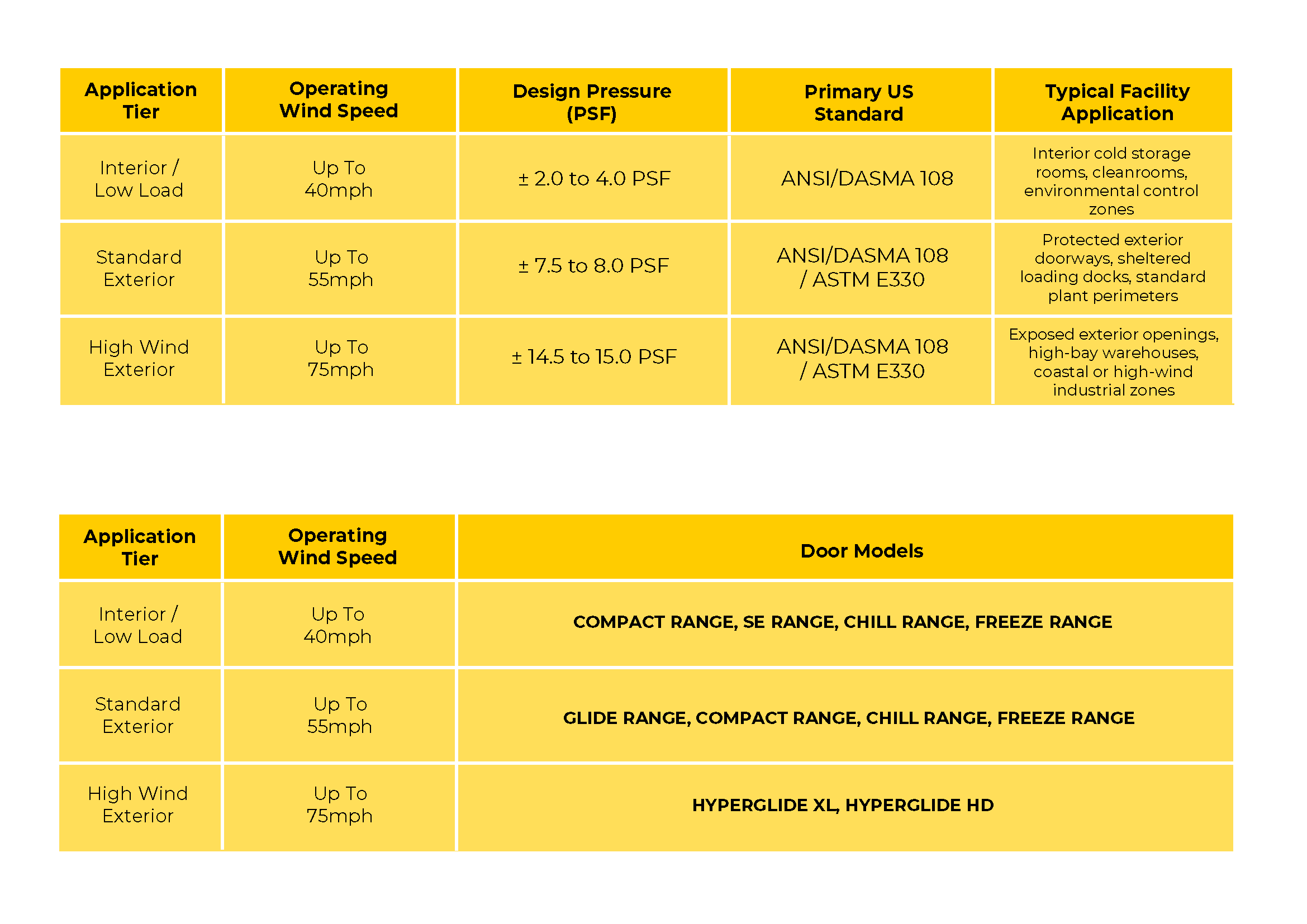
Understanding US Standards: ANSI/DASMA 108 & ASTME330
In the United States, industrial door wind load performance is primarily evaluated under ANSI/DASMA108 (Standard Method for Testing Sectional Garage Doors and Rolling Doors) and tested using ASTM E330 (Standard Test Method for Structural Performance of Exterior Doors and Curtain Walls). Design pressures are calculated in accordance with ASCE 7 guidelines referenced in the International Building Code (IBC).
Talk to our team
Have a question about our high speed doors or safety systems? Reach out and our specialists will reply within two to three business days.

.jpg)